CASTECHBLOCK FIX-GP
High-Performance Block Fixing and General-Purpose Masonry Mortar
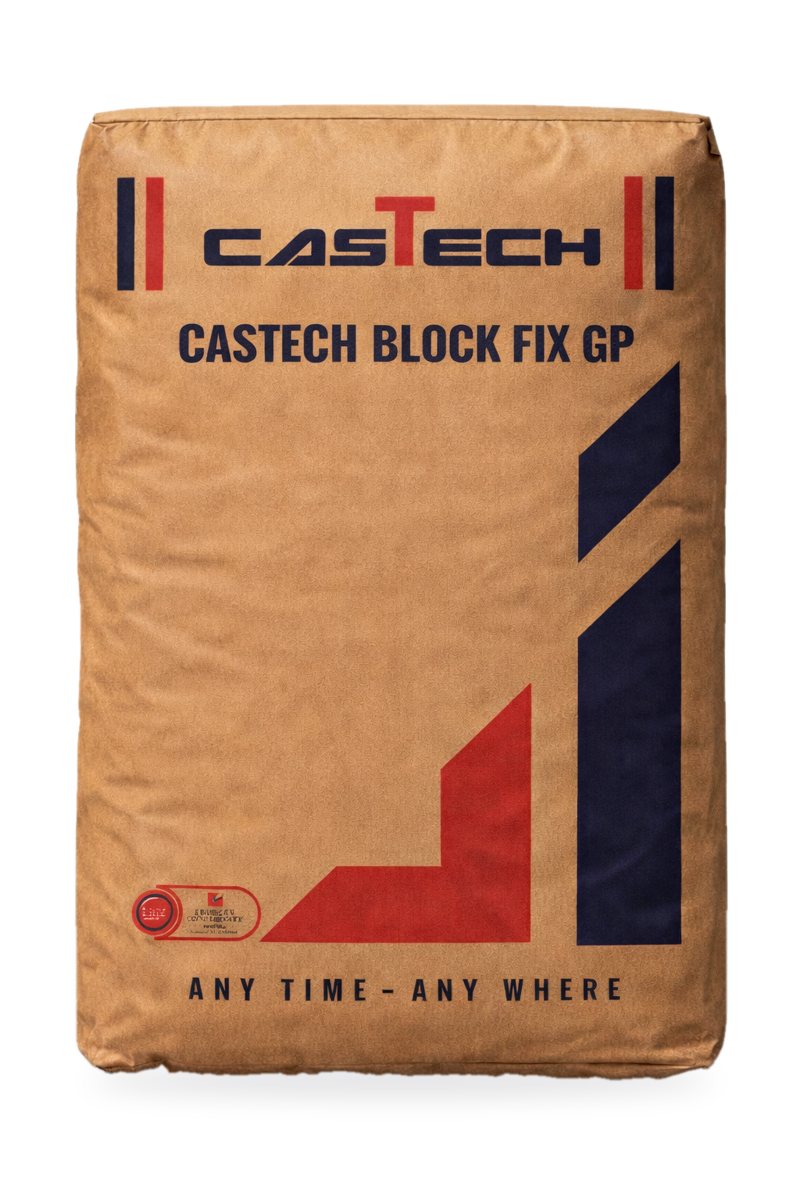
CASTECH Block Fix GP is a premium, polymer-modified, pre-blended cementitious mortar developed for the rapid and durable installation of concrete blocks, clay bricks, lightweight blocks, and other compatible masonry units.
Overview
About
CASTECH Block Fix GP is a premium, polymer-modified, pre-blended cementitious mortar developed for the rapid and durable installation of concrete blocks, clay bricks, lightweight blocks, and other compatible masonry units. Its factory-controlled formulation provides good workability, extended working time, high compressive strength, and reduced shrinkage, offering a consistent and efficient alternative to conventional site-mixed masonry mortar.
Typical uses
- Laying concrete blocks, clay bricks, and lightweight masonry units
- General masonry construction and repair work
- Joint applications typically ranging from 3-10 mm
- Interior and exterior blockwork requiring consistent strength and reduced shrinkage
Standards
The source technical data identifies ASTM C270, Type M as the mortar classification and ASTM C109 as the compressive- strength test reference.
Compatibility
- Concrete blocks
- Clay bricks
- Lightweight masonry blocks
- General masonry repair applications
- Calcium-silicate | bricks | only | after | representative compatibility testing
Important Technical Note
The source TDS specifies a 3–10 mm joint thickness in the uses and application sections, while its technical-data table separately lists a 10–40 mm bed-layer thickness. The approved application range shall be confirmed by the CASTECH Technical Department before external issue.
Benefits
Advantages
Key advantages
- Factory-preblended formulation for consistent site performance
- Extended working time of approximately 60 minutes
- High 28-day compressive strength
- Controlled shrinkage for durable masonry joints
- Good workability and ease of application
- High coverage and reduced on-site material handling
Technical data
| Appearance | Grey, free-flowing powder |
|---|---|
| Chemical base | Polymer-modified cementitious mortar |
| Wet density | Approx. 2.00 ± 0.05 kg/L |
| Water requirement | 10.0-10.5 L per 50 kg bag |
| Water/powder ratio | Approx. 0.20–0.21 by weight |
| Recommended joint thickness | Approx. 3-10 mm |
| Working time | Approx. 60 minutes |
| Coverage | Approx. 12–16 m²/50 kg at 3 mm |
| 28-day compressive strength | ≥20 N/mm² - ASTM C109 |
| Application temperature | +5°C to +40°C |
| Standard reference | ASTM C270, Type M |
| Packaging | 50 kg bag |
Typical values. Refer to the TDS for full details and test conditions.
Application
Surface preparation
Masonry units
The block or brick surfaces shall be sound, clean, and free from dust, oil, loose particles, and contaminants that may affect adhesion.
Moisture conditioning
Pre-wet highly absorbent masonry units as required. The units shall be damp but free from standing or running water at the time of application.
Base and alignment
Ensure the receiving surface and first masonry course are level and properly aligned before continuing with subsequent courses.
Mixing
Use a clean container and a mechanical mixer fitted with a suitable paddle. Measure 10.0–10.5 liters of clean water for each 50 kg bag. Add the powder gradually to the water while mixing continuously for 3–5 minutes until a homogeneous, lump- free mortar is obtained. Allow the mortar to stand for approximately 5 minutes, then remix briefly before application. Do not exceed the recommended water dosage, and do not add extra water after the mortar begins to set.
Masonry Mortar
Application
Mortar placement
Apply the mixed mortar using a suitable trowel, notched trowel, or approved mechanical applicator. Spread an even bed suitable for the type and dimensional tolerance of the masonry unit.
Block placement
Place the masonry unit onto the fresh mortar and adjust it immediately to the required line, level, and plumb. Ensure full contact across the bed and vertical joints.
Joint control
Maintain a uniform joint thickness, typically 3–10 mm, unless otherwise approved for the specific masonry system. Remove excess mortar before it hardens.
Initial protection
Protect completed work from premature drying, direct sunlight, rain, and strong wind. Do not disturb newly completed masonry until sufficient strength has developed.
Coverage
Typical coverage is approximately 12–16 m² per 50 kg bag at an average thickness of 3 mm. Coverage is theoretical and will vary with masonry-unit dimensions, surface condition, joint thickness, application method, and wastage.
Curing
Lightly water-cure the completed masonry for 3 days by spraying approximately 3–4 times daily, subject to site temperature, humidity, and project requirements.
Limitations
- Do not apply below +5°C or above +40°C.
- Do not apply to frozen surfaces or in rain.
- Do not exceed the recommended water dosage.
- Do not retemper mortar after it begins to set.
- Suitability for calcium-silicate bricks must be confirmed by testing.
- Protect freshly completed masonry from rapid drying and adverse weather.
Packaging & storage
Packaging
- 50 kg moisture-resistant paper bags
Storage & shelf life
6 months from the date of manufacture when stored unopened in the original, undamaged packaging under the recommended conditions. Store in dry conditions below +30°C and at a relative humidity below 60%. Keep bags sealed, off the ground, and protected from moisture, direct sunlight, and physical damage. Do not stack pallets more than five layers high. Use stock rotation and do not use material from damaged bags or material that has hardened because of moisture exposure.
Health & safety
CASTECH Block Fix GP contains cement and becomes alkaline when mixed with water. Avoid contact with skin and eyes. Wear suitable gloves, safety goggles, and a dust mask during handling, mixing, and application. In case of eye contact, rinse immediately with plenty of clean water and seek medical attention. If swallowed, seek medical advice immediately. Refer to the latest Safety Data Sheet for detailed handling and disposal guidance. Dispose of product waste and empty packaging in accordance with local regulations.