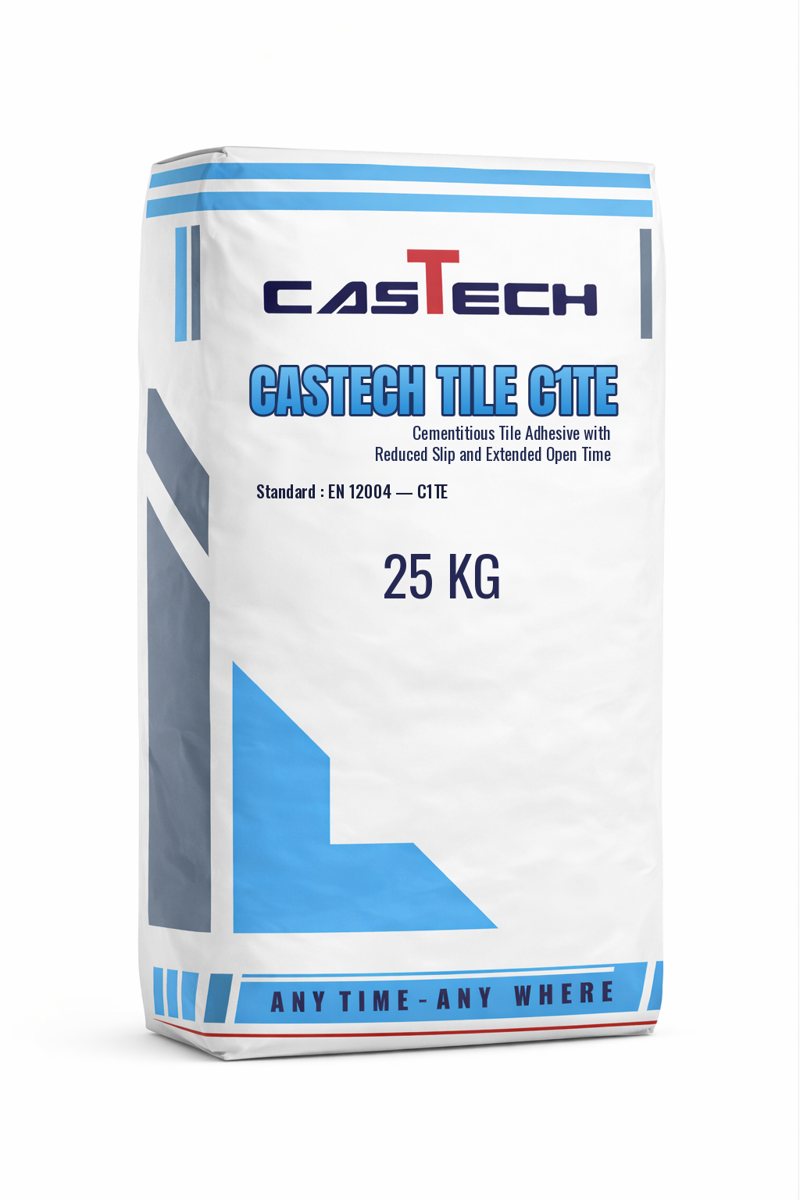
CASTECHTILE C1TE
Cementitious Tile Adhesive with Reduced Slip and Extended Open Time
CASTECH Tile C1TE is a single-component, polymer-modified cementitious tile adhesive supplied as a factory-blended powder.
Overview
About
CASTECH Tile C1TE is a single-component, polymer-modified cementitious tile adhesive supplied as a factory-blended powder. When mixed with clean water, it forms a smooth, workable mortar with reduced slip and extended open time for reliable fixing of ceramic tiles on prepared cementitious substrates. The product is intended for standard interior and exterior wall and floor tiling. It is particularly suitable for small-and medium-format ceramic tiles with water absorption above approximately 3%, subject to the substrate, exposure, and project requirements.
Typical uses
- Interior and exterior ceramic-tile installation on walls and floors
- Bathrooms, kitchens, utility areas, and other moisture-prone locations
- Residential, commercial, and institutional tiling works
- Concrete, cement-sand render, cement screed, and compatible masonry surfaces
- Cement backer boards and other approved rigid cementitious boards
- Small-and medium-format ceramic tiles on vertical and horizontal surfaces
Standards
CASTECH Tile C1TE is designed to meet the C1TE performance requirements of EN 12004 for cementitious ceramic-tile adhesives, based on the stated test data and subject to project specification requirements. and Extended Open Time
Benefits
Advantages
Key advantages
- C1TE | classification: | normal-setting cementitious adhesive with reduced slip and extended open time
- Good adhesion under dry, wet, heat, and freeze-thaw conditioning
- Reduced tile slip during vertical application
- Extended open time supports efficient tile placement
- Smooth workability and easy application by notched trowel
- Factory-controlled, single-component system —only clean water is required
- Available in grey and white
Technical data
| Appearance / colour | Grey or white powder |
|---|---|
| Chemical base | Polymer-modified cementitious mortar |
| Water addition | 5.0-6.0 L per 25 kg bag |
| Application temperature | +5°C to +35°C |
| Service temperature | -20°C to +70°C |
| Working time at 23°C | Approx. 45 minutes |
| Open time | 30 minutes |
| Slip resistance | ≤0.5 mm |
| Tensile adhesion strength | ≥0.5 N/mm² |
| Mixed yield | Approx. 18 L per 25 kg bag |
| Coverage at 3 mm | Approx. 7.5 m² per 25 kg bag |
| Packaging | 25 kg kraft bag |
| Shelf life | 12 months |
| Classification | C1TE cementitious tile adhesive |
| Open time - EN 12004-2 | ≥0.5 N/mm² after 30 minutes |
| Initial tensile adhesion | ≥0.5 N/mm² after dry storage |
| Water-immersion adhesion | ≥0.5 N/mm² after conditioning |
| Heat-ageing adhesion | ≥0.5 N/mm² after conditioning |
| Freeze-thaw adhesion | ≥0.5 N/mm² after conditioning |
| Slip - EN 12004-2 | ≤0.5 mm |
| Reaction to fire - EN 13501-1 | Class A1 |
| Coverage | Approx. 7.5 m²/bag at 3 mm |
Typical values. Refer to the TDS for full details and test conditions.
Application
Surface preparation
General requirements
The substrate shall be sound, dimensionally stable, clean, and free from dust, laitance, oil, grease, paint, curing compounds, release agents, loose particles, and other materials that may impair adhesion. Remove contamination by suitable mechanical means.
Repairs and levelling
Repair cracks, cavities, and weak areas with an appropriate CASTECH repair material. Allow repairs and new cementitious substrates to cure adequately before tile fixing. Uneven surfaces shall be levelled before adhesive application; the adhesive shall not be used to correct excessive substrate irregularity.
Absorbent cementitious surfaces
Lightly dampen highly absorbent concrete, render, or screed with clean water before application. Remove all standing water; the substrate shall be in a saturated- surface-dry condition. Do not apply onto surfaces exposed to running water.
Existing tiles and smooth surfaces
Existing ceramic, terrazzo, marble, or other dense surfaces shall be mechanically roughened and thoroughly cleaned. Confirm bond by a representative site trial. Use a suitable CASTECH primer or bonding system where required by the substrate condition and approved method statement.
Boards and gypsum-based substrates
Boards shall be rigid, securely fixed, and suitable for tiling. Gypsum-based or highly absorbent substrates require a compatible approved primer and shall be protected from moisture in accordance with the board and waterproofing- system requirements.
Mixing
Use a clean container and a slow-speed, heavy-duty drill fitted with a suitable mixing paddle. Measure 5.0–6.0 litres of clean potable water for each 25 kg bag, depending on the required workable consistency and site conditions. Add the powder gradually to the water while mixing continuously. Mix until a smooth, homogeneous, and lump- free mortar is obtained. Allow the mix to stand for approximately 3 minutes, then remix for about 2 minutes before application. Do not add cement, sand, other materials, or water beyond the recommended range. Mix only the quantity that can be used within the working time. Do not retemper material that has started to stiffen or set.
Application
Adhesive spreading
Apply the adhesive onto the prepared substrate using the flat side of a trowel to produce a contact layer, then comb immediately with a correctly selected notched trowel. Spread only an area that can be tiled within the stated open time.
Tile fixing
Press tiles firmly into the fresh adhesive with a slight sliding or twisting action to collapse the ribs and achieve uniform bedding. Periodically remove a tile to verify transfer and coverage. Back- butter tiles where required, particularly for exterior work, wet areas, or tiles with deep rear profiles.
Adjustment and open time
Complete tile positioning while the adhesive remains fresh. If a surface skin has formed, remove the adhesive and apply fresh material; do not re-wet or remix the skinned mortar. Clean dusty tile backs before fixing.
Bedding coverage
Provide full and continuous adhesive contact in permanently wet, external, floor, heavily trafficked, or other demanding applications. Avoid voids behind tiles. Select the trowel notch and application technique according to tile size, substrate flatness, and project requirements.
Movement and perimeter joints
Do not bridge structural, movement, control, or isolation joints with adhesive or tiles. Continue the joints through the tiled finish and seal them using an approved flexible joint-sealant system. Provide perimeter and intermediate movement joints as required by the project design. Protect freshly installed tiles from rain, direct sunlight, strong wind, frost, vibration, impact, and premature traffic. Do not expose the installation to water or service conditions until adequate strength has developed. As a general guide, wall joints may be filled after approximately 8 hours and floor joints after approximately 24 hours at 23°C. Cooler conditions, dense tiles, low-absorption substrates, or thick adhesive beds will extend these periods. Follow the selected grout and project requirements.
Coverage
Approximate mixed yield is 18 litres per 25 kg bag. Typical coverage is approximately 7.5 m² per 25 kg bag at a uniform 3 mm bed thickness. Actual consumption depends on substrate profile, tile-back profile, trowel notch, bedding coverage, and wastage.
Limitations
- For natural stone susceptible to staining, moisture sensitivity, or dimensional movement, complete a compatibility trial and use a purpose-designed adhesive where required.
- For porcelain, glass mosaic, large-format, heavy tiles, facades, immersed conditions, heated floors, or highly deformable substrates, select a higher-performance
- Do not use directly over gypsum, timber, metal, plastics, waterproofing membranes, or existing coatings unless the complete substrate and primer system has been technically approved.
- Installation performance depends on substrate preparation, adhesive contact, tile properties, joint design, weather, and workmanship.
Packaging & storage
Packaging
- 25 kg moisture-resistant kraft bag
Storage & shelf life
12 months from the date of manufacture when stored unopened in the original packaging under the recommended conditions. Store under cover in a cool, dry, and shaded warehouse, off the ground, and protected from moisture, direct sunlight, and extreme temperature or humidity. Keep bags sealed until use and follow stock rotation.
Health & safety
CASTECH Tile C1TE contains cement and becomes alkaline when mixed with water. Avoid inhalation of dust and contact with eyes, skin, mouth, and foodstuffs. Wear protective gloves, safety goggles, suitable clothing, and a dust mask during mixing and application. In case of eye contact, rinse immediately with plenty of clean water and seek medical attention. Wash affected skin with soap and water. If swallowed, do not induce vomiting; seek immediate medical advice. Keep away from children and animals. Do not reuse empty packaging. Dispose of product residue and packaging in accordance with applicable local regulations. Refer to the latest Safety Data Sheet (SDS) before use.