CASTECHTILE WP
Highly Polymer-Modified Waterproof Cementitious Tile Adhesive
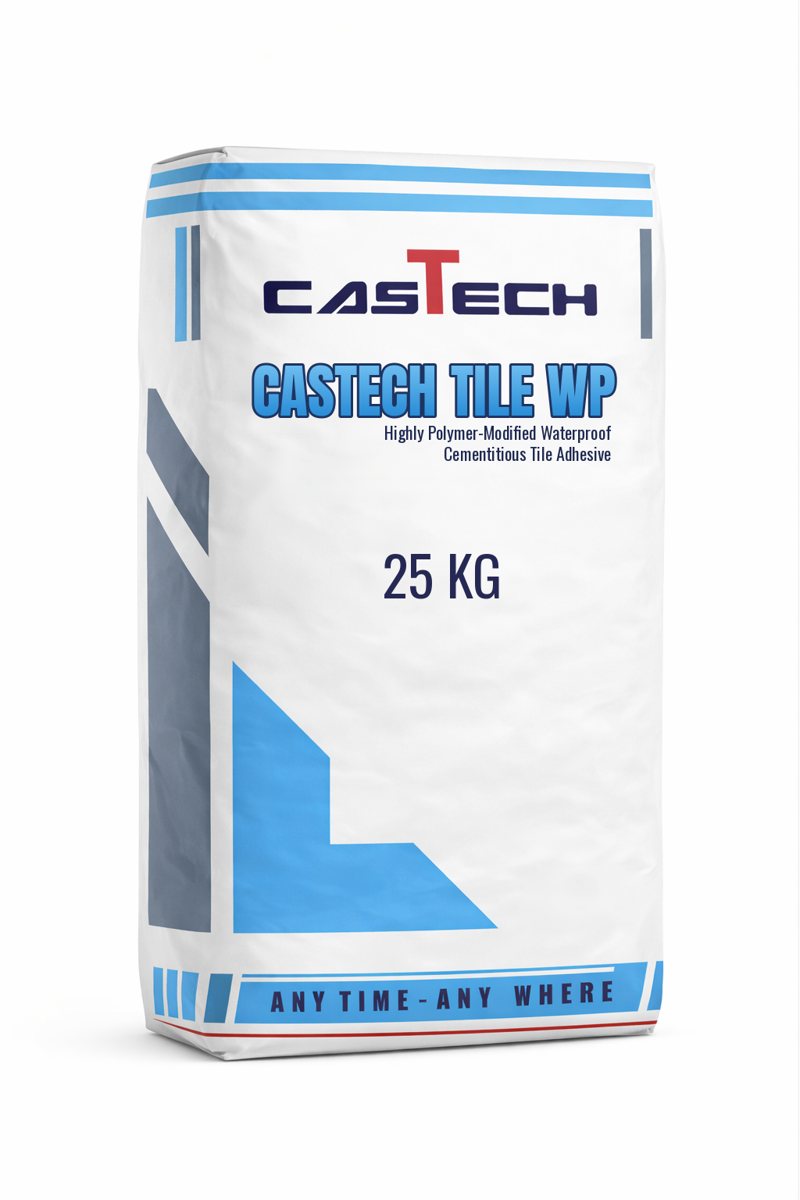
CASTECH Tile WP is a single-component, highly polymer-modified, waterproof cementitious thin-bed tile adhesive supplied as a factory-blended grey or white powder.
Overview
About
CASTECH Tile WP is a single-component, highly polymer-modified, waterproof cementitious thin-bed tile adhesive supplied as a factory-blended grey or white powder. When mixed with clean water, it forms a smooth, cohesive mortar with high adhesion and improved flexibility for demanding wall and floor tile installations. CASTECH Tile WP is designed for fixing granite, vitrified tiles, glass mosaics, glass bricks, and ceramic wall and floor tiles in interior and exterior locations. It is suitable for use on properly prepared Portland-cement renders, floor screeds, concrete, and compatible gypsum boards, subject to the approved project system and site conditions. The product is intended for moisture-prone applications and may be used in wet areas such as showers and swimming pools when applied with full adhesive contact over an approved waterproofing system. CASTECH Tile WP shall not be used directly on wood, metal sheets, or painted surfaces.
Typical uses
- Fixing granite and vitrified tiles
- Installation of glass mosaics and glass bricks
- Bonding ceramic wall and floor tiles
- Interior and exterior residential and commercial tiling
- Wet areas, shower rooms, and swimming pools as part of an approved tiling and waterproofing system
- Thin-bed fixing on concrete, cement render, cement screed, and compatible boards
Standards
CASTECH Tile WP is formulated and tested with reference to ANSI A118.4, BS 5980 Type 1 Class AA, and the tensile-adhesion test method described in BS EN 1348. Project-specific compliance shall be verified against the approved specification and supporting test reports.
Benefits
Advantages
Key advantages
- Highly polymer modified for strong adhesion and improved flexibility
- Waterproof | and | moisture-resistant performance after full curing
- Suitable for a wide range of low-absorption and conventional tiles
- Smooth, cohesive consistency and easy application by notched trowel
- Suitable for interior and exterior wall and floor applications
- Helps accommodate normal thermal and service stresses
- Single-component system—only clean water is
Tile Adhesive
added on site
- Available in grey and white
Technical data
| Appearance / colour | Grey or white powder |
|---|---|
| Composition | Portland cement, graded sand and polymer additives |
| Binder | Portland cement |
| Maximum aggregate size | Approx. 0.5 mm |
| Water addition | 5.0-6.0 L per 25 kg bag |
| Wet density | Approx. 1.75 kg/L |
| Application temperature | +5°C to +35°C |
| Working time at 23°C | Approx. 30 minutes |
| Maximum usable time | Up to 45 minutes under standard conditions |
| Application thickness | 3-5 mm |
| Initial tensile adhesion | >1.0 N/mm² at 28 days |
| Packaging | 25 kg bag |
| Shelf life | 12 months |
| Product type | Highly polymer- modified waterproof cementitious tile adhesive |
| Theoretical coverage | Approx. 2.9-4.8 m²/bag at 5-3 mm |
Typical values. Refer to the TDS for full details and test conditions.
Application
Surface preparation
General requirements
The substrate and tile backs shall be sound, clean, and free from dust, laitance, sinter skin, oil, grease, formwork release agent, paint, and other contaminants that may impair adhesion. Remove weak or contaminated material by suitable mechanical means.
Repairs and levelling
Repair cracks, cavities, honeycombing, and weak areas using an appropriate CASTECH repair material. Allow new concrete, render, screed, and repairs to cure adequately. Level excessive irregularities before tiling; do not use the adhesive to compensate for major substrate deviations.
Pre-wetting and suction control
Dampen absorbent cementitious backgrounds with clean potable water to reduce excessive suction. Allow free surface water to disperse before applying the adhesive. The substrate shall be damp but free from standing or running water.
Tiles and dense surfaces
Clean tile backs to remove dust and manufacturing residue. Pre-wetting of highly absorbent tiles may be required; follow the tile manufacturer’s recommendations. Dense, smooth, or low-absorption surfaces shall be mechanically roughened or treated with an approved CASTECH primer where required. Complete a representative adhesion trial before general application.
Boards and restricted substrates
Gypsum boards shall be dry, rigid, securely fixed, and primed with an approved compatible primer. Do not apply directly to timber, metal sheets, plastics, bituminous materials, painted surfaces, or unstable substrates. Obtain CASTECH technical approval for non-standard substrates.
Mixing
Use a clean plastic container or a non-corrosive metal tub and a slow-speed heavy-duty drill fitted with a suitable paddle. Measure 5.0–6.0 litres of clean potable water for each 25 kg bag. Add CASTECH Tile WP powder gradually to the water while mixing continuously. Mix until a smooth, homogeneous, and lump-free mortar is obtained. Allow the mixture to stand for approximately 5 minutes, then remix briefly before application. Use mixed material within approximately 45 minutes under standard conditions. Do not add cement, sand, admixtures, or other materials. Do not add extra water after mixing, and do not retemper or remix material that has started to stiffen or set.
Application
Adhesive spreading
Apply CASTECH Tile WP in one coat using the flat side of a trowel to form a contact layer. Immediately comb the material in one direction with a correctly selected serrated or notched trowel to obtain a uniform adhesive bed of approximately 3–5 mm.
Working area and open time
Spread only an area that can be tiled while the adhesive remains fresh, generally not more than approximately 1 m² at a time. If a surface skin forms or transfer to the tile is inadequate, remove the material and apply fresh adhesive. Do not re-wet skinned adhesive.
Tile fixing
Press tiles firmly into the fresh adhesive using a slight sliding or twisting motion to collapse the ribs and ensure good contact. Periodically lift a tile to verify transfer and coverage. The tile arrangement shall allow the required movement and grout joints. Wet areas, pools and critical installations In wet areas, swimming pools, shower rooms, exterior areas, with large-format tiles, glass products or heavy tiles, achieve solid bedding with no voids or air pockets behind the tile. Apply additional adhesive uniformly to the tile back where necessary to obtain full contact. Use CASTECH Tile WP only as part of an approved waterproofing, adhesive, grout and sealant system. Glass, natural stone and special tiles Glass mosaic, glass brick, granite and other special materials may require specific primers, white adhesive, movement-joint design or installation methods. Confirm compatibility, staining risk and adhesion by a representative trial and follow the tile manufacturer’s instructions. Protect freshly installed tiles from rain, running water, direct sunlight, strong wind, frost, vibration, impact and premature traffic. Do not fill pools or expose the installation to continuous water until the adhesive, grout, waterproofing and sealants have fully cured in accordance with the approved system. Joint filling shall be carried out only after the adhesive has hardened sufficiently. The required waiting period depends on tile absorption, substrate, bed thickness, temperature and ventilation. Follow the approved method statement and grout manufacturer’s instructions.
- BS 5980 - adhesive for use with ceramic tiles and mosaics; Type 1, Class AA reference stated in the former data sheet
- BS EN 1348 - determination of tensile adhesion strength for cementitious tile adhesives The standards listed reflect the references stated in the former product data. They do not, by themselves, constitute third-party certification or a declared EN 12004 classification. Project-specific compliance shall be verified against approved test reports and specification requirements.
Coverage
Theoretical consumption is approximately 1.75 kg/m² per millimetre of wet adhesive thickness. This corresponds to approximately 4.8 m² per 25 kg bag at 3 mm and approximately 2.9 m² per bag at 5 mm. Actual consumption depends on the substrate profile, tile-back profile, trowel notch, bedding coverage, and wastage.
Limitations
- For facades, very large or heavy tiles, heated floors, deformable substrates, permanent immersion, or critical glass installations, obtain CASTECH technical approval and use the specified complete system.
- Do not use directly over timber, metal, plastics, bituminous surfaces, coatings, or waterproofing membranes unless the complete compatible system has been technically approved.
- Gypsum-based substrates require suitable priming and protection from moisture in accordance with the approved system.
- Natural stone may be moisture sensitive, stain prone, or dimensionally unstable. Complete a compatibility trial before use.
- Installation performance depends on substrate preparation, adhesive contact, tile properties, movement-joint design, environment, and workmanship.
Packaging & storage
Storage & shelf life
12 months from the date of manufacture when stored unopened in the original packaging under the recommended conditions. Store under cover in a cool, dry, and shaded warehouse, off the ground, and protected from moisture, direct sunlight, and extreme temperature or humidity. Keep bags sealed until use and follow stock rotation.
Health & safety
CASTECH Tile WP contains cement and becomes alkaline when mixed with water. Avoid inhalation of dust and contact with eyes, skin, mouth, and foodstuffs. Wear protective gloves, safety goggles, suitable clothing, and a dust mask during mixing and application. In case of eye contact, rinse immediately with plenty of clean water and seek medical attention. Wash affected skin with soap and water. If swallowed, do not induce vomiting; seek immediate medical advice. Keep away from children and animals. Do not reuse empty packaging. Dispose of product residue and packaging in accordance with applicable local regulations. Refer to the latest Safety Data Sheet (SDS) before use.