CASTECHTILE JOINT GROUT
Polymer-Modified Cementitious Tile Joint Grout
CASTECH Tile Joint Grout is a single-component, polymer-modified cementitious grout supplied as a factory-blended colored powder. When mixed with clean water, it forms a smooth, creamy, and workable paste for filling joints between wall and floor tiles.
Overview
About
CASTECH Tile Joint Grout is a single-component, polymer-modified cementitious grout supplied as a factory-blended colored powder. When mixed with clean water, it forms a smooth, creamy, and workable paste for filling joints between wall and floor tiles. The selected binders, graded fillers, and polymer additives provide good adhesion, reduced shrinkage, water resistance, and a uniform decorative finish. The product is suitable for interior and exterior applications and for joint widths up to 12 mm, subject to tile type, exposure, and project requirements.
Typical uses
- Joint filling for ceramic and porcelain wall and floor tiles
- Kitchens, bathrooms, shower areas, and other moisture-prone locations
- Residential, commercial, and institutional tiling works
- Swimming pools and exterior tiling, subject to the approved waterproofing system and full curing
- Grade A joints up to 5 mm and Grade B joints from 5-12 mm
- Compatible natural-stone applications after a representative stain and cleanability trial
- Tiled surfaces incorporating underfloor heating, subject to movement-joint and heating-system requirements
Compatibility
Suitable for ceramic and porcelain tiles and for compatible natural stone after approval of a trial area. The grout may be used with cementitious tile adhesives and on correctly prepared cement-based backgrounds. Porous, textured, polished, or moisture-sensitive tiles shall be assessed before application.
Benefits
Advantages
Key advantages
- Polymer-modified cementitious formulation with good water resistance
- Smooth, creamy consistency for easy filling and finishing
- Good adhesion and reduced risk of cracking or shrinkage when correctly applied
- Suitable for walls and floors, indoors and outdoors
- Available in a wide range of standard and project colours
- Single-component system—only clean water is required at site
- Easy cleaning of fresh residue from suitable tile surfaces
Technical data
| Appearance | Coloured powder |
|---|---|
| Chemical base | Polymer-modified cementitious mortar |
| Standard colours | White, grey, yellow, green, blue, red, brown, and black |
| Additional colours | Wide range subject to availability |
| Water addition - 20 kg | Approx. 5.6–6.4 L |
| Water addition - 25 kg | Approx. 7.0–8.0 L |
| Fresh mixed density | Approx. 1.8 kg/L |
| Working time at 23°C | Approx. 30 minutes |
| Recommended joint width | Up to 12 mm |
| Grade A joint range | Up to 5 mm |
| Grade B joint range | 5-12 mm |
| Indicative coverage | Approx. 1 kg / 4 m²* |
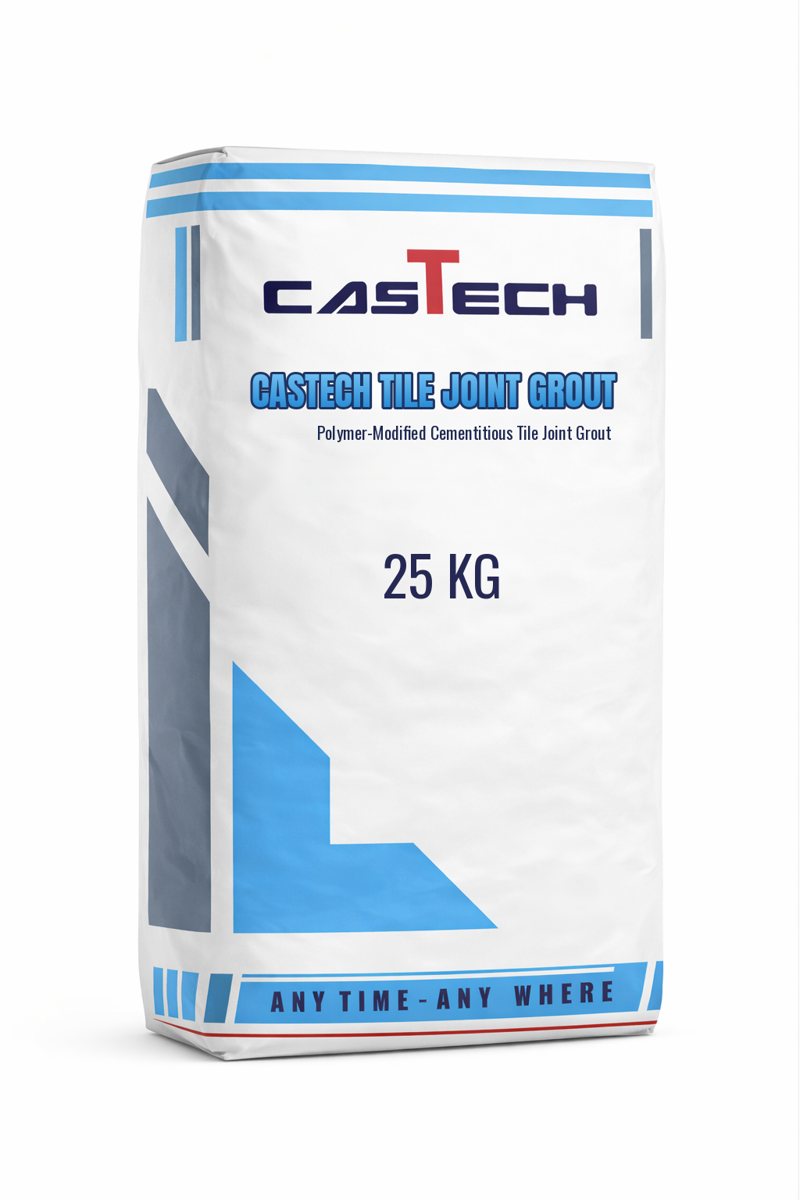
| Packaging | 25 kg kraft bag |
| Shelf life | 12 months |
| Product type | Polymer-modified cementitious tile grout |
| Joint width | Up to 12 mm |
| Water/powder ratio | Approx. 0.28–0.32 by mass |
Typical values. Refer to the TDS for full details and test conditions.
Application
Mixing
Use a clean container and a slow-speed drill fitted with a suitable paddle. For each 25 kg bag, measure approximately 7.0–8.0 litres of clean potable water. This is equivalent to the former product ratio of 5.6–6.4 litres per 20 kg of powder. Add the powder gradually to the water while mixing continuously until a smooth, homogeneous, and lump-free paste is obtained. Allow the mix to stand for approximately 10 minutes, then remix briefly before application. Use the same water ratio for each batch to minimize shade variation. Do not add cement, pigments, sand, or other materials. Do not exceed the recommended water addition, and do not retemper grout that has started to stiffen or set.
Application
Joint Preparation
General requirements
Allow the tile adhesive to harden adequately before grouting; as a general guide, wait at least 24 hours unless the adhesive data sheet or project conditions require a longer period. The tiles shall be firmly fixed and free from movement.
Joint condition
Remove excess adhesive, spacers, dust, and loose contamination from the joints. Joints shall be open to a uniform depth and sufficiently clean to receive grout. Uneven joint depth may cause non-uniform drying and colour variation.
Tile surface assessment
Complete a representative trial on porous, textured, matt, polished, metallic-glazed, or natural-stone tiles to confirm that the grout can be applied and cleaned without staining, scratching, or leaving a visible residue. Pre-sealing may be required for absorbent materials.
Moisture condition
Where tiles or joints are highly absorbent, lightly dampen with clean water without leaving standing water. Do not grout saturated joints or surfaces exposed to running water.
Joint filling
Spread the mixed grout over the tile surface using a rubber grout float or a suitable squeegee. Work diagonally across the joints and press firmly to completely fill and compact the joint without voids.
Initial cleaning
Remove excess grout from the tile surface with the edge of the float. After the grout has started to firm, clean diagonally with a clean, slightly damp sponge. Rinse the sponge frequently and use the minimum water necessary to avoid washing cement and pigment from the joint.
Final finishing
Shape the joint uniformly during cleaning. When a dry haze remains, polish the tile surface with a clean, soft, and dry cloth. Do not use aggressive cleaning chemicals or flood the surface during early curing.
Coverage
As an indicative guide, approximately 1 kg may cover 4 m² when used with 150 x 150 mm tiles. Actual consumption varies significantly with tile size, tile thickness, joint width, joint depth, surface texture, and application loss. A site calculation or trial is recommended.
Curing
Protect freshly grouted areas from direct sunlight, strong wind, rain, frost, dust, vibration, traffic, and premature washing until sufficient strength has developed. Hot, dry, or windy conditions can cause rapid moisture loss and color variation. For swimming pools, wet areas, and exterior applications, allow the grout to cure fully before immersion or continuous water exposure, and follow the approved waterproofing, movement- joint, and commissioning requirements.
Limitations
- Not intended for structural, movement, or expansion joints.
- Not suitable where high chemical, acid, solvent, or severe stain resistance is required; use an appropriate
- Do not apply over unstable tiles, contaminated joints, flexible substrates, or joints subject to active movement.
- Natural stone and highly porous tiles may stain or retain grout residue; complete a compatibility trial and pre-seal where necessary.
- Swimming-pool and permanently wet applications require an approved waterproofing system, adequate curing, and project-specific acceptance.
- Performance and shade depend on preparation, water dosage, joint geometry, weather, cleaning, and workmanship.
Packaging & storage
Packaging
- 25 kg moisture-resistant kraft bag
Storage & shelf life
12 months from the date of manufacture when stored unopened in the original packaging under the recommended conditions. Store under cover in a cool, dry, and shaded warehouse, off the ground, and protected from moisture, direct sunlight, and extreme temperature or humidity. Keep bags sealed until use and follow stock rotation.
Colour And Appearance
Final colour may vary slightly from the shade card or sample due to water addition, mixing, joint depth, tile absorption, cleaning technique, drying rate, site temperature, and production batch. Approve a representative trial area before full application, especially for large or visually critical surfaces. For the most uniform appearance, use material from the same batch, maintain consistent mixing and cleaning methods, and complete continuous areas without long interruptions. Do not introduce additional pigment on site.
Health & safety
CASTECH Tile Joint Grout contains cement and becomes alkaline when mixed with water. Avoid inhalation of dust and contact with eyes, skin, mouth, and foodstuffs. Wear protective gloves, safety goggles, suitable protective clothing, and a dust mask during mixing and application. In case of eye contact, rinse immediately with plenty of clean water and seek medical attention. Wash affected skin with soap and water. If swallowed, do not induce vomiting; seek immediate medical advice. Keep away from children and animals. Do not reuse empty packaging. Dispose of product residue and packaging in accordance with applicable local regulations. Refer to the latest Safety Data Sheet (SDS) before use.